

IFRS S1 and IFRS S2 in Pakistan establish sustainability-related financial disclosure requirements for specified listed companies and qualifying non-listed Public Interest Companies under the Securities and Exchange Commission of Pakistan (SECP) framework. These standards require covered entities to report material sustainability-related and climate-related risks and opportunities that could affect their business prospects.
The requirements are being introduced in phases based on company eligibility and reporting-period dates. Phase I applies to eligible annual reporting periods beginning on or after 1 July 2025, Phase II begins on or after 1 July 2026, and Phase III begins on or after 1 July 2027, according to the published framework. Companies should confirm their classification, applicable thresholds and any subsequent regulatory updates before finalizing their reporting obligations. SECP Adoption Order | IFRS Foundation’s Pakistan Jurisdictional Profile.
Who Must Comply With IFRS S1 And S2 In Pakistan?
The SECP adopted IFRS S1 and IFRS S2 through a phase-wise framework. Its scope covers Pakistan Stock Exchange (PSX)-listed companies according to the relevant phase criteria and qualifying non-listed Public Interest Companies in Phase III.
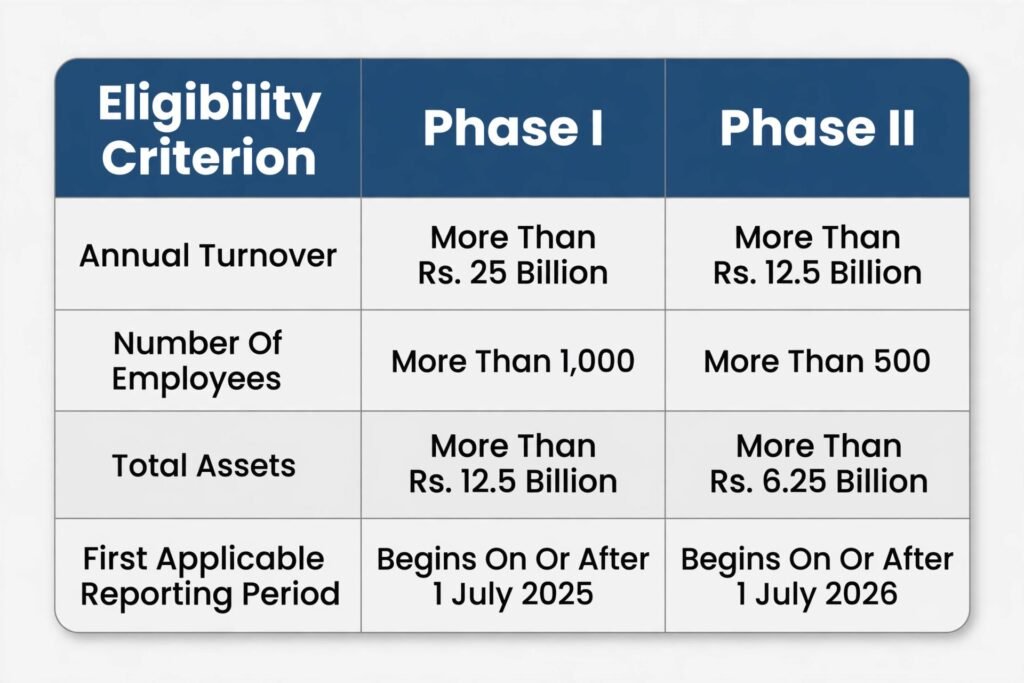
For listed companies, Phase I and Phase II eligibility is assessed using three criteria: annual turnover, number of employees and total assets. A company must meet at least two of the three criteria for the relevant phase, subject to the applicable reporting-period requirements.
What Are The Phase I And Phase II Thresholds?
The published Pakistan jurisdictional profile identifies the following thresholds for listed companies:
Do Unlisted SMEs Need To Comply With IFRS S1 And S2?
Not every unlisted small or medium-sized enterprise automatically falls within the mandatory scope. Phase III includes remaining listed companies and qualifying non-listed Public Interest Companies covered by the SECP framework. An unlisted business should assess its legal classification and regulatory status rather than assuming that its size alone determines whether the standards apply. Businesses outside the mandatory scope may still receive sustainability-information requests from lenders, investors, customers or business partners. Such requests are distinct from a direct reporting obligation under the SECP framework.What Are IFRS S1 And IFRS S2?
IFRS S1 and IFRS S2 are sustainability disclosure standards issued by the International Sustainability Standards Board (ISSB). They are designed to help investors, lenders and other creditors understand sustainability-related risks and opportunities that could affect an entity’s prospects.What Does IFRS S1 Cover?
IFRS S1, General Requirements For Disclosure Of Sustainability-Related Financial Information, establishes the general requirements for disclosing material sustainability-related risks and opportunities. Companies report information about matters that could reasonably be expected to affect their cash flows, access to finance or cost of capital over the short, medium or long term. The standard does not require a company to report every environmental, social or governance topic regardless of its relevance to the entity’s prospects.What Does IFRS S2 Cover?
IFRS S2, Climate-Related Disclosures, focuses on climate-related risks and opportunities. These can include physical risks, such as extreme weather, and transition risks arising from changes in policy, technology, markets or other conditions associated with the transition to a lower-carbon economy. The Key Difference: IFRS S1 provides the broader framework for material sustainability-related disclosures, while IFRS S2 addresses climate-related disclosures specifically.What Is The Reporting Timeline For IFRS S1 And S2 In Pakistan?
The SECP framework introduces the standards through three phases.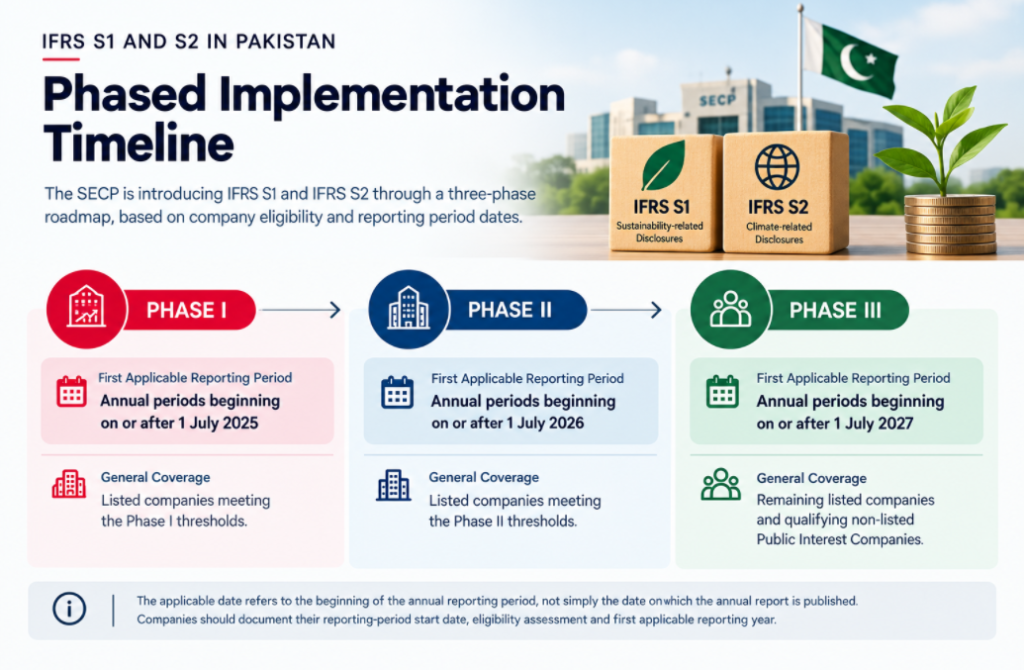 The applicable date refers to the beginning of the annual reporting period, not simply the date on which the annual report is published. Companies should document their reporting-period start date, eligibility assessment and first applicable reporting year.
Because regulatory requirements can change, entities should review the current SECP order and any subsequent notifications before relying on the timeline for compliance planning.
The applicable date refers to the beginning of the annual reporting period, not simply the date on which the annual report is published. Companies should document their reporting-period start date, eligibility assessment and first applicable reporting year.
Because regulatory requirements can change, entities should review the current SECP order and any subsequent notifications before relying on the timeline for compliance planning.
What Must Companies Disclose Under IFRS S1 And S2?
The standards organize disclosures around four connected areas: governance, strategy, risk management, and metrics and targets. The information reported should address the material risks and opportunities relevant to the company and the detailed requirements of the applicable standards.1. Governance: Who Oversees Sustainability-Related Risks?
Companies explain the governance processes, controls and procedures used to oversee sustainability-related risks and opportunities. Disclosures may cover the responsibilities of the board and management, how oversight is exercised and how relevant responsibilities are integrated into existing governance arrangements.2. Strategy: How Could Sustainability Affect Business Prospects?
Companies explain how material sustainability-related risks and opportunities could affect their business model, strategy and financial prospects over the short, medium and long term. For climate-related matters, this may include exposure to extreme weather, changes in regulation, technology developments or market shifts. The disclosures should explain the potential business implications rather than simply list sustainability concerns.3. Risk Management: How Are Risks Identified And Monitored?
Companies describe the processes used to identify, assess, prioritize and monitor relevant sustainability-related risks and opportunities. They should also explain how these processes connect with the organization’s wider risk management arrangements.4. Metrics And Targets: How Is Performance Measured?
Companies disclose the metrics and targets required by the applicable standards for material sustainability-related risks and opportunities. Climate-related disclosures may include greenhouse gas emissions, climate-related targets and progress against those targets. Reported figures should be supported by appropriate records, documented calculation methods and clear assumptions.What Are The Greenhouse Gas Emissions Disclosure Requirements Under IFRS S2?
IFRS S2 includes greenhouse gas emissions disclosure requirements. Emissions are commonly grouped into three scopes: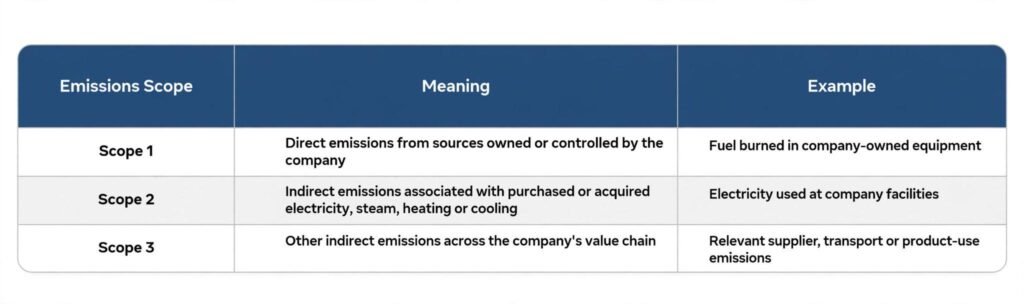 The applicable requirements and transition provisions determine which information must be disclosed for a particular reporting period. Scope 3 data can be especially challenging because it may depend on information from suppliers, logistics providers and other value-chain participants.
Companies should identify relevant data sources early, assign responsibility for collecting information and document the methods and assumptions used.
The applicable requirements and transition provisions determine which information must be disclosed for a particular reporting period. Scope 3 data can be especially challenging because it may depend on information from suppliers, logistics providers and other value-chain participants.
Companies should identify relevant data sources early, assign responsibility for collecting information and document the methods and assumptions used.
What Transition Relief Is Available In The First Reporting Year?
IFRS S1 and IFRS S2 include transition provisions intended to support initial implementation. Depending on the applicable provision and circumstances, these may address climate-first reporting, comparative information, the timing of disclosures and Scope 3 emissions. Companies should distinguish between a temporary transition provision and a permanent exemption. The availability and conditions of each relief should be checked against the applicable standards and Pakistan’s regulatory framework.Can Companies Report Only Climate-Related Information In The First Year?
The climate-first transition relief in IFRS S1 and IFRS S2 may allow an entity applying the standards for the first time to limit its first-year sustainability-related disclosures to climate-related risks and opportunities, subject to the relevant requirements. This is a temporary transition provision, not a permanent exemption from broader sustainability-related disclosures. Companies should plan for the additional applicable requirements in subsequent reporting periods.Is Scope 3 Emissions Reporting Required In The First Year?
IFRS S2 provides a first-year transition relief from disclosing Scope 3 greenhouse gas emissions. Companies should confirm the conditions that apply to their reporting period and prepare for subsequent requirements. Early planning can help companies identify supplier and value-chain data sources, establish collection procedures and document calculation methods.Can Sustainability Disclosures Be Published Separately From Financial Statements?
The IFRS Foundation’s Pakistan Jurisdictional Profile describes a first-year transition provision allowing sustainability-related financial disclosures to be published separately within nine months after the financial year-end, subject to the applicable conditions. Outside the relevant transition provision, disclosures are generally required alongside the related financial statements under the applicable requirements. Companies should verify the current SECP requirements and publication timetable before finalizing their reporting arrangements.Where Should IFRS S1 And S2 Disclosures Be Published?
Under the Pakistan framework described in the IFRS Foundation’s jurisdictional profile, sustainability-related financial disclosures are to be included in the annual report after the directors’ report, subject to the applicable first-year transition relief. Finance teams should coordinate sustainability reporting with the financial reporting timetable, management review and governance approvals. Clear ownership of preparation and approval responsibilities can help reduce data gaps and delays.Is Independent Assurance Required For IFRS S1 And S2 Reporting In Pakistan?
The SECP’s announcement of the adoption framework stated that assurance on sustainability reporting by the company’s auditor would begin from the second year of reporting. However, the applicable assurance standards and any subsequent regulatory developments should be verified before a company determines its precise obligations. Companies should review the latest SECP notifications and relevant assurance requirements rather than relying solely on an older summary or jurisdictional profile. Regardless of the applicable assurance timetable, maintaining supporting evidence, documenting assumptions and calculations, and establishing review controls can improve the reliability of sustainability disclosures.How Should Companies Prepare For IFRS S1 And S2 Reporting?
A practical preparation plan should address regulatory applicability, disclosure gaps, governance, data collection and publication.- Confirm Applicability And Reporting Dates: Determine the company’s regulatory status, relevant threshold calculations, applicable phase and first reporting period.
- Conduct A Disclosure Gap Assessment: Compare existing reporting processes with IFRS S1 and IFRS S2 requirements. Identify missing information, weak controls and unassigned responsibilities.
- Assign Responsibilities Across Departments: Identify who will provide, review and approve information. Depending on the business, this may involve finance, operations, procurement, risk management and senior leadership.
- Establish Reliable Data Collection Processes: Identify the systems and records needed to support reported metrics. Document source data, calculation methods, assumptions and review procedures.
- Assess Material Risks, Opportunities And Targets: Identify matters that could reasonably be expected to affect the company’s prospects and determine the applicable disclosures.
- Plan Review And Publication: Set a timetable for data collection, management review, governance approval and publication. Allow time to resolve data gaps and verify regulatory requirements.
What Common IFRS S1 And S2 Reporting Mistakes Should Companies Avoid?
Common implementation risks include:- Applying The Wrong Threshold Test: Checking only one criterion instead of assessing whether at least two of the three criteria are met.
- Confusing Reporting Dates: Using the annual report publication date rather than the beginning of the relevant reporting period.
- Treating Sustainability Reporting As Marketing: Publishing broad ESG statements without addressing applicable disclosure requirements.
- Using Unsupported Metrics: Reporting figures without documented sources, assumptions or calculation methods.
- Delaying Value-Chain Data Collection: Waiting until year-end to identify Scope 3 data sources.
- Misunderstanding Transition Relief: Treating a temporary first-year provision as a permanent exemption.
- Leaving Responsibilities Unclear: Failing to identify who collects, reviews and approves the information.
Preparing For IFRS S1 And S2 Compliance In Pakistan
IFRS S1 and IFRS S2 introduce phased sustainability-related financial disclosure requirements for specified listed companies and qualifying non-listed Public Interest Companies in Pakistan. Applicability depends on regulatory status, the relevant thresholds and the beginning of the annual reporting period. Companies should begin by confirming their reporting phase and first applicable period. They can then assess disclosure gaps, assign responsibilities, establish reliable data collection and review processes, and verify the transition provisions and assurance requirements that apply to their circumstances. Early preparation helps finance teams establish a repeatable reporting process, support the reliability of disclosures and reduce avoidable gaps in future reporting periods.